Most golfers who try to practice at home start by buying something, then work out where it fits. We suggest doing it the other way round. This guide to how to practice golf at home starts with the space you have, then matches it to the practice that space can actually support.
A hallway, a spare bedroom and a two-car garage are three different labs. Each one can improve a part of your game. None of them can improve all of it, and that is fine.
Step one: measure before you buy
Before you look at any gear, answer three questions about the room.
- Can you swing a club at full speed? Take the longest club you plan to use and make slow, full-length rehearsal swings. Watch the ceiling on the way up and the walls on the follow-through. If anything is close, that room is for short swings and putting only.
- Can a ball fly safely? Hitting real balls indoors needs a net or an impact screen, a mat, and room behind and around you. No net, no full shots.
- What is the floor? Carpet, hardwood, tile and concrete all change what stays put under your feet and under a training aid.
Your answers put you in one of three setups below. Most people are in the first or second, and they make faster progress than they expect because they practice more often.
Setup 1: A hallway or living room (no full swings)
This is the smallest space and, for many golfers, the most useful one. The skills it trains show up on every hole: setup, alignment, ball position and putting.
Setup and alignment
Most misses start before the club moves. If your feet, hips and shoulders aim right of the target, a straight swing still sends the ball right. Practicing your address position at home is cheap, quiet and fast.
The Swing Plate from SwingPlate is built for exactly this. It is a hand-adjustable alignment plate that, per the product description, covers setup and stance consistency, ball position relative to the swing arc, and alignment to target and feet. It weighs 1 kg and can be reconfigured mid-session without tools. It works with standard alignment sticks, and purchase includes lifetime access to the SwingPlate PGA Online Coaching Library for structured drill progressions.
Drill: the ten-setup check. Set the plate to a target line. Walk away, come back, and take your address ten times in a row without looking down at the plate until you are set. Then check feet, ball position and clubface. Count how many of the ten were correct. Write the number down. That number is your baseline.
Putting
Putting is the one part of the game you can practice at home with almost no compromise. Start line is the skill that matters most on short putts, and it is easy to measure indoors.
The Putting Gate from SwingPlate gives you two gates, 55mm and 60mm, to roll the ball through, plus a 4.25-inch slot that matches the width of a regulation hole. It fits any SwingPlate base unit via the included adapter; the base is sold separately. The product notes that a 55mm gap from 14 inches allows less than 1 degree of start-line error.
For a full set of indoor putting drills, read our guide on how to practice putting at home.
Setup 2: A spare room or garage corner (short swings, contact focus)
If you can make half swings but not full ones, your target is contact. Fat and thin shots come from the club reaching the ground in the wrong place. You can train that with no ball at all.
Low point and strike
The Divotboard MINI is sized for this kind of space. Its description says the sequin surface shows strike location and divot pattern on every swing, with no batteries, app or interpretation needed. It has three anchor systems: suction cups, tees and spikes. The feedback pad is Velcro-backed and lasts between 1,000 and 3,000 swings depending on use; Mini Replacement Pads are sold separately.
On a hard floor, the suction cups alone may not hold it in place. The Divotboard Mini Grip Pad, sold separately, is a silicone base that holds the MINI in place on hardwood, tile or concrete and softens impact on hard floors.
Drill: the line test. Imagine a line where the ball would sit. Make five half swings and look at where each mark starts. The goal is for every mark to start on or just past that line, never behind it. When you can do five in a row, make the swings a little longer.
Build the motion, then add speed later
A small room is a good place to rehearse positions slowly: the top of a half swing, the shaft at waist height on the way down, the finish. Slow, correct reps here make full swings in the bigger space easier to change.
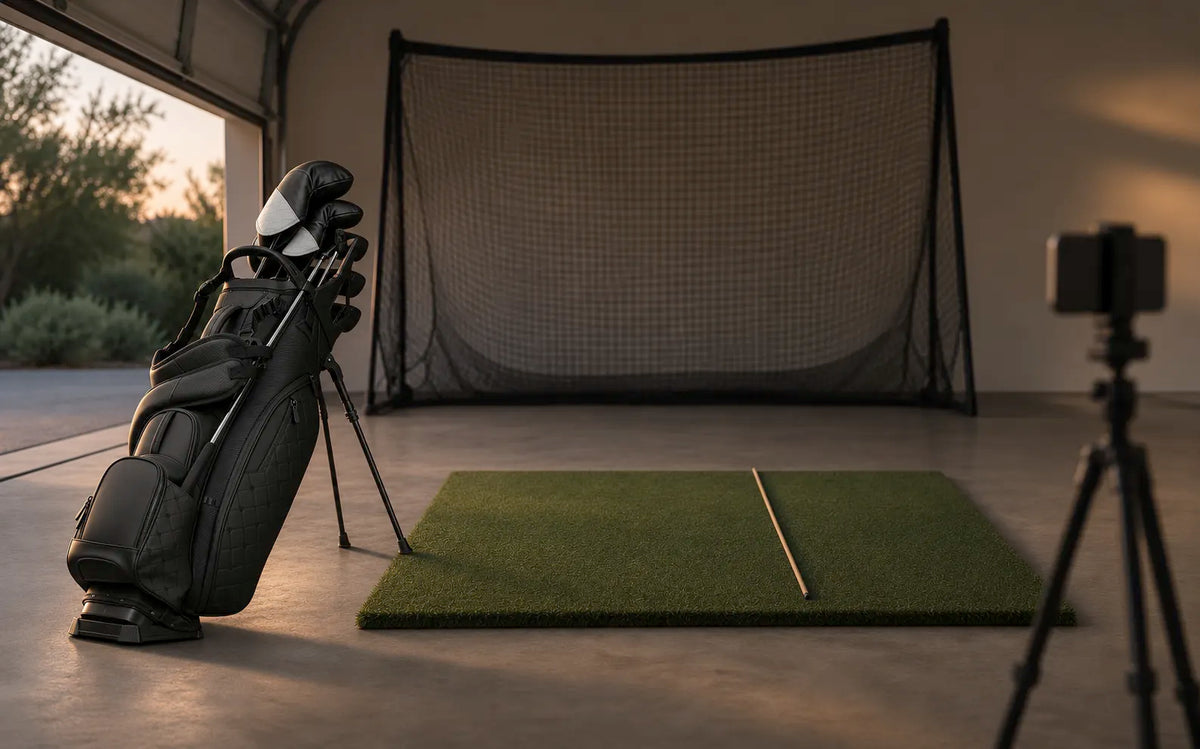
Setup 3: A garage or bay with a net (full swings with numbers)
If you can swing freely and hit balls safely into a net, you can work on the full swing. This is also where a launch monitor earns its place, because a ball hit into a net tells you very little on its own.
The surface
Hitting off a hard floor or a thin mat is hard on your joints and hides fat shots. A proper turf mat matters. If you already use the full-size Divotboard, the Divotboard Turf Mat 4×5 has a custom cut-out that seats the Original Divot Board flush with the hitting surface, so you get ground-contact feedback through the board on full swings. It has a 1/2-inch foam base, and the board itself is sold separately.
The numbers
Into a net, you cannot see carry distance or curve. A launch monitor fills that gap. Two examples at very different levels:
- Shot Scope LM1. A compact K-band doppler radar unit that measures club speed, ball speed, smash factor, carry distance and total distance. It sits 55 inches (1.4 meters) behind the ball and works indoors and outdoors. The description is clear about its limits: it does not measure spin, club path, attack angle or face angle.
- FlightScope Mevo Gen2. Combines 3D doppler radar with synchronized image processing and reports 17 full-swing parameters, including spin rate, spin axis, launch angles and angle of attack. Indoors it needs 16 feet in total: 8 feet of ball flight plus 8 feet behind the ball. Spin readings indoors need the included aluminum stickers or Titleist RCT balls.
If you are unsure what the numbers mean, start with club speed and carry. Our breakdown of how the PGA Tour's longest hitters gain distance explains why speed, launch and spin matter more than the driver model.
Film it
A phone on a stand is the cheapest coach in the room. The GPOD Travel tripod collapses to 9 inches and extends to 62 inches, and it ships with a Bluetooth remote so you can start recording without walking back to the phone. Film from face-on and down the line, then compare one swing per session to last week's.
How can I practice golf at home in 20 minutes?
Gear helps, but structure is what makes home practice carry over to the course. Short sessions you actually do beat long sessions you skip. Here is a 20-minute plan that works in any of the three setups.
- Minutes 0 to 5: setup. Ten addresses with an alignment check. Record how many were correct.
- Minutes 5 to 12: one skill. Pick one: start line on putts, low point on half swings, or one launch monitor number on full swings. Do not mix them.
- Minutes 12 to 18: test. Turn the skill into a score. For example, ten putts through the 60mm gate, or five swings in a row with the mark starting past the line.
- Minutes 18 to 20: log it. Write down the date, the skill and the score. Next session, try to beat it.
That is 5 + 7 + 6 + 2 = 20 minutes. Three of these a week is an hour of focused practice, more than many golfers manage at the range.
How to practice your golf swing at home without building bad habits
A few habits separate home practice that helps from home practice that builds bad patterns.
- Do not chase speed in a small room. If you are shortening your swing to miss the ceiling, you are training a different swing. Keep full speed for the space that allows it.
- Always use a target. A line on the floor, a stick, a gate. Swinging at nothing teaches nothing.
- Change one thing at a time. If you are working on ball position, leave grip and posture alone until the new position feels normal.
- Measure something every session. A count, a number or a video. Without a score, you cannot tell if you are improving.
- Take it outside. Every few weeks, check the work on a range or course. Home practice is the lab; the course is the test.
Where to start
If you only buy one thing, match it to the space and the skill you will practice most:
- Hallway or living room: an alignment and putting setup such as the Swing Plate and Putting Gate.
- Spare room or garage corner: contact feedback such as the Divotboard MINI, plus the Mini Grip Pad on hard floors.
- Garage with a net: a turf mat and a launch monitor matched to the numbers you need.
Browse the full range in our Home Practice collection, filtered for gear that works indoors and in tight spaces.
Sources
- Product descriptions, Elevation Golf Lab store, checked October 29, 2026: The Swing Plate, The Putting Gate, Divotboard MINI Compact Feedback, Divotboard Mini Grip Pad, Divotboard Turf Mat 4×5 Mat Only, Shot Scope LM1 Launch Monitor, Mevo Gen2, GPOD Travel.