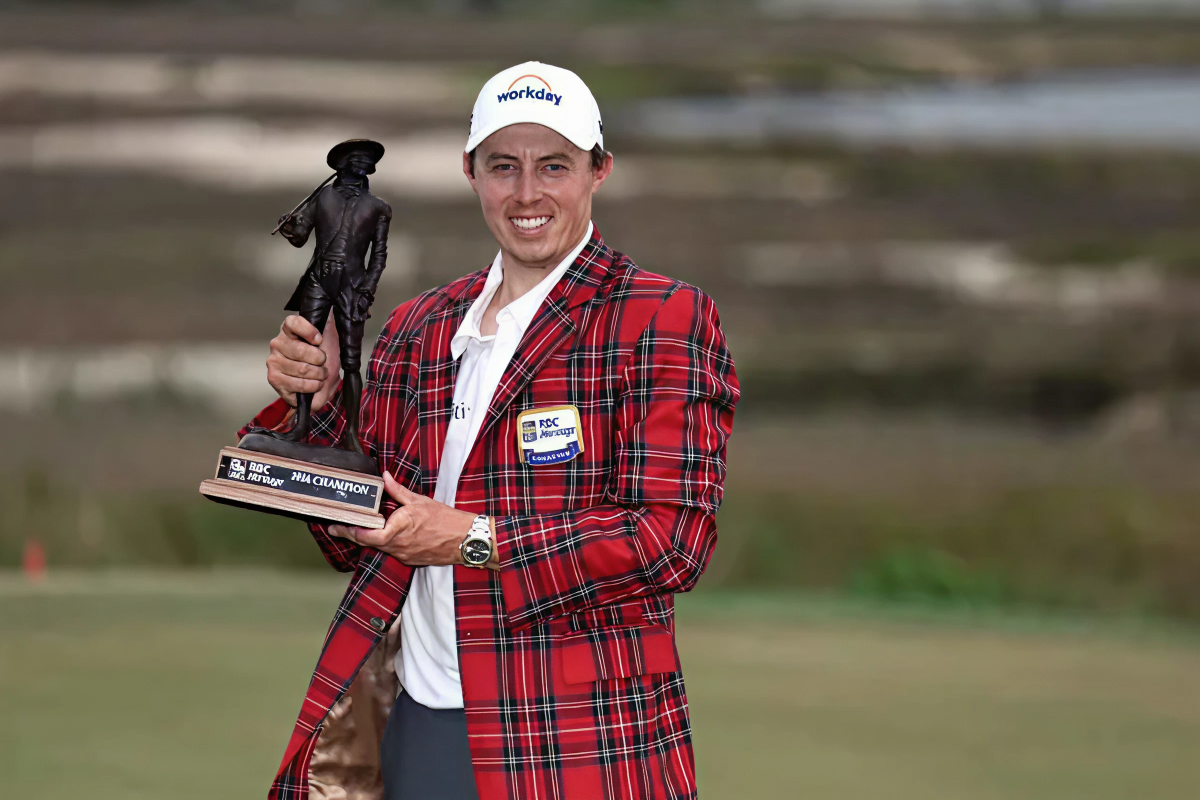
Matt Fitzpatrick's victory at the 2026 RBC Heritage wasn't just about reading Harbour Town's tricky winds or navigating its narrow fairways. It was a masterclass in precision iron play, the kind that only comes from deliberate, data-driven practice. While other players rely on raw power or feel, Fitzpatrick has built his game around repeatable mechanics and obsessive attention to detail.
So what Matt Fitzpatrick training drills actually produce that level of consistency? From alignment routines to TrackMan sessions and short-game sharpness work, his practice habits are less about variety and more about refinement. If you've ever wondered how a tour pro maintains ball-striking that holds up under Sunday pressure, here's a look inside the drills and tools that keep Fitzpatrick's iron play razor-sharp.
Alignment Stick Drills for Consistent Setup
Fitzpatrick is meticulous about his alignment, and he uses alignment sticks in nearly every range session. The setup is simple but effective: one stick on the ground aimed at the target, another parallel to it for his feet and body line. This creates a visual reference that eliminates guesswork and ingrains a square setup.
He'll often place a third stick across his chest or along his lead arm to monitor shoulder tilt and swing plane. The goal isn't just to aim correctly, it's to train his body to return to the same positions repeatedly. At Harbour Town, where even a few degrees offline can cost you a birdie look, that consistency pays off.
For amateurs, this drill is one of the easiest to replicate. Lay two sticks parallel on the range, hit 20 balls without adjusting them, and check your divot patterns. If your divots drift left or right, your alignment is off. Fitzpatrick's discipline here is a reminder that tour-level ball-striking starts before the swing ever begins.
TrackMan and Data-Driven Practice
Fitzpatrick doesn't just hit balls, he measures them. Like most modern tour players, he relies heavily on TrackMan to track carry distance, spin rates, launch angle, and dispersion patterns. But what separates him is how he uses that data to build specific yardages and shot shapes into his practice.
He'll pick a target carry number, say 165 yards with a 7-iron, and hit a dozen balls trying to land within a five-yard window. TrackMan gives him instant feedback on whether he's spinning it too much, coming in too steep, or missing his launch window. Over time, this builds a library of reliable stock shots he can pull from on the course.
At the RBC Heritage, Harbour Town's small greens and firm conditions demand exact yardages. Fitzpatrick's ability to dial in a 172-yard carry versus a 178-yard carry comes directly from hours spent chasing precision on TrackMan. If you have access to a launch monitor, even a cheaper unit like a Garmin Approach R10, you can apply the same principle. Pick one club, one target distance, and measure your consistency over 15 swings.
Short-Game Repetition Under Pressure
Fitzpatrick's short game isn't flashy, but it's relentless. He's known for spending significant time on lag putting drills, particularly from 30 to 50 feet. His go-to drill is simple: drop three balls at 30, 40, and 50 feet, and try to leave every putt inside a three-foot circle. If one goes long or short by more than that margin, he starts over.
This isn't about holing putts, it's about speed control and eliminating three-putts. At Harbour Town's slick, undulating greens, lag putting becomes a scoring separator. Fitzpatrick's discipline here shows up in his stats: he consistently ranks in the top 20 on tour for three-putt avoidance.
He also practices greenside chips with a specific landing spot in mind. He'll place a towel or alignment stick two paces onto the green and try to land five consecutive chips on it, varying the club (gap wedge, sand wedge, lob wedge) but keeping the landing zone the same. This trains his distance control and spin awareness, two skills that kept him tight to pins all week at Hilton Head.
Impact Bag Work for Strike Quality
Fitzpatrick has been seen using an impact bag during warm-ups and practice sessions, particularly when he's working on compression and strike quality. The drill is straightforward: swing into the bag at half speed, focusing on a flat left wrist, forward shaft lean, and body rotation through impact.
The impact bag gives instant tactile feedback. If you flip your wrists or hang back, the bag won't compress cleanly. Fitzpatrick uses it to ingrain the feeling of a tour-quality strike, where the ball is caught on a descending blow with the hands ahead of the clubhead. This is the foundation of his iron play, the reason he can flight a 6-iron low into the wind or hold a 9-iron on a tucked pin.
You don't need an expensive impact bag to try this. A heavy duffel bag stuffed with towels works. Focus on making 20 slow, controlled swings into the bag, feeling your body rotate and your hands lead. It's unglamorous work, but it's the kind of drill that builds the muscle memory behind Fitzpatrick's ball-striking consistency.
FAQ: Matt Fitzpatrick's Training and Practice
Does Matt Fitzpatrick use a specific launch monitor?
Fitzpatrick primarily uses TrackMan during practice sessions, both on the range and indoors. TrackMan provides the detailed ball flight and club data he relies on to dial in yardages and optimize spin rates for different conditions.
What is Matt Fitzpatrick's practice routine like?
Fitzpatrick's practice is highly structured and data-focused. He typically starts with alignment and setup drills using alignment sticks, moves into iron work with TrackMan for feedback, and finishes with extensive short-game repetition, including lag putting and chip landing drills.
How does Matt Fitzpatrick practice his short game?
Fitzpatrick focuses on lag putting drills from 30 to 50 feet, aiming to leave every putt inside a three-foot circle. He also practices chips with specific landing zones, using different wedges to train distance control and spin consistency.
Can amateurs use the same drills as Matt Fitzpatrick?
Absolutely. Alignment stick drills, impact bag work, and short-game repetition routines require minimal equipment and can be adapted to any skill level. The key is consistency and measurable goals, just like Fitzpatrick applies in his own practice.
Building Tour-Level Habits Into Your Own Practice
You don't need Fitzpatrick's talent to benefit from his approach. What separates tour players isn't just skill, it's structure. Every drill he uses has a measurable goal, whether that's TrackMan dispersion, lag putt distance control, or alignment stick feedback. His practice isn't about hitting balls until he's tired, it's about hitting balls until the data says he's dialed in.
If you take one thing from Fitzpatrick's RBC Heritage win, let it be this: precision comes from repetition with a purpose. Pick one drill, set a clear target, and track your progress over 10 sessions. Whether it's alignment sticks, a launch monitor, or a simple chip-and-land routine, the discipline you build will show up when it matters most.